 Get full access to premium PowerPoint templates at a limited-time price.Get Now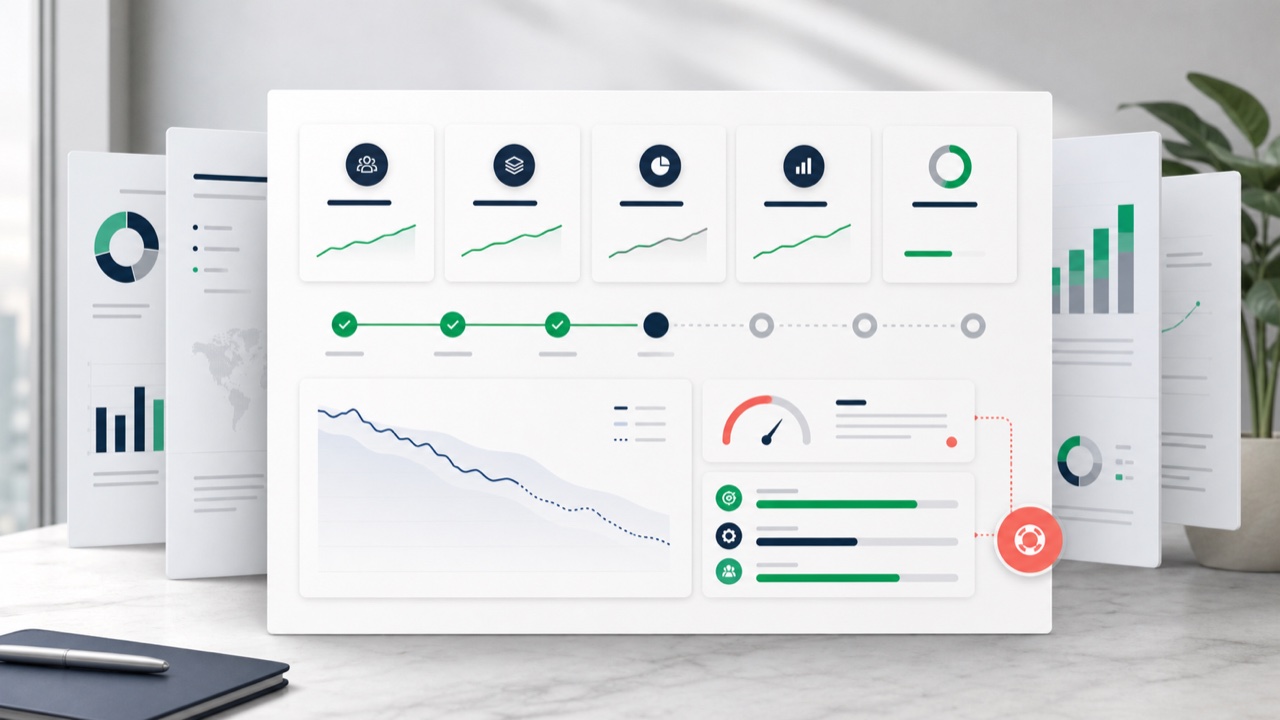
An investor update presentation should explain what changed, why it changed, what management is doing next, and where investors can help. It is not a shortened fundraising pitch deck. Existing investors already know the company story; they need signal, context, ownership, and a concise request.
A useful monthly or quarterly update lets an investor answer:
Consistency matters. Keep the core slide order and metric definitions stable so trends can be compared without relearning the deck each period.
State the period, overall assessment, strongest result, most important miss, and one priority. This is a conclusion slide, not an agenda.
Show a small set of metrics tied to the business model. Include actual, target, prior period, and variance where useful. Do not mix cumulative and period values without clear labels.
Report revenue, pipeline, retention, customer count, or another commercial measure relevant to the stage. Explain quality, not only volume.
Show completed milestones, delayed work, and the consequence for the plan. Avoid treating routine activity as progress.
Choose a few developments that changed the company's position: a major customer, validated channel, product result, partnership, hire, or operational improvement.
State misses directly. Explain the cause, what was learned, and what changes. Defensive language reduces confidence more than an honest, controlled explanation.
Show cash balance, burn, runway, and material forecast changes. Define whether burn is gross or net and state the reporting date.
List three to five priorities with a measurable outcome and owner. The list should show focus, not every team activity.
Describe the most important risks, their impact, and mitigation. Highlight decisions where investor or board input is required.
Make requests specific: introductions to named customer profiles, candidates for a defined role, advice on a particular decision, or feedback on a concrete plan. “Any help is appreciated” is difficult to act on.
Choose metrics that explain the operating model.
Do not present a large dashboard without interpretation. Add a short note beside material changes so the investor understands the driver and management response.
Use the Startup Financing Modern Corporate Pitch Deck Template for funding and milestone layouts, the Investment Pitch Decks Business PowerPoint Template for a broad investor-ready system, or the Pitch Deck PowerPoint Template for a flexible 30-slide base.
Select only the layouts needed for recurring updates. A monthly investor deck should normally be shorter than a fundraising presentation.
| Investor update | Fundraising pitch deck |
|---|---|
| Written for existing investors | Written for prospective investors |
| Focuses on change since the last period | Establishes the company and opportunity |
| Uses stable recurring metrics | Builds an investment narrative |
| Includes misses, risks, and direct asks | Emphasizes potential, evidence, team, and raise |
| Often monthly or quarterly | Used during a funding process |
Create the update from one controlled reporting source. Freeze the data date, reconcile the core metrics, and ask functional owners for short explanations of material changes. Draft the executive summary only after the scorecard, cash position, wins, misses, and priorities have been reviewed.
Send the update on a predictable date, even when the period was difficult. Maintain an action log for introductions, advice, and commitments created by the previous update. At the next reporting cycle, close the loop on those requests. This turns the presentation into an operating rhythm rather than a one-way status document.
If the business changes a metric definition, show both the old and new treatment for a transition period and explain the reason. Silent definition changes make trend comparisons unreliable.
For fundraising structure, read How to Create a Startup Pitch Deck. For a stage-specific deck, use the Seed Pitch Deck guide.
A concise recurring update can often fit in 6 to 10 main slides, with detailed financial and product information in an appendix.
Many early-stage companies use a monthly rhythm, while more mature companies may update quarterly. Choose a cadence the team can maintain consistently.
Yes. State material misses or risks with context, ownership, and a response plan. Surprising investors later is usually more damaging than reporting a controlled issue now.
Ask for specific introductions, candidates, expertise, feedback, or decisions. Include enough context for the investor to act without a long follow-up.
Get full access to our entire collection of premium PPT templates for one simple price.
Forget about complex tools or technical skills—just choose, edit, and download.