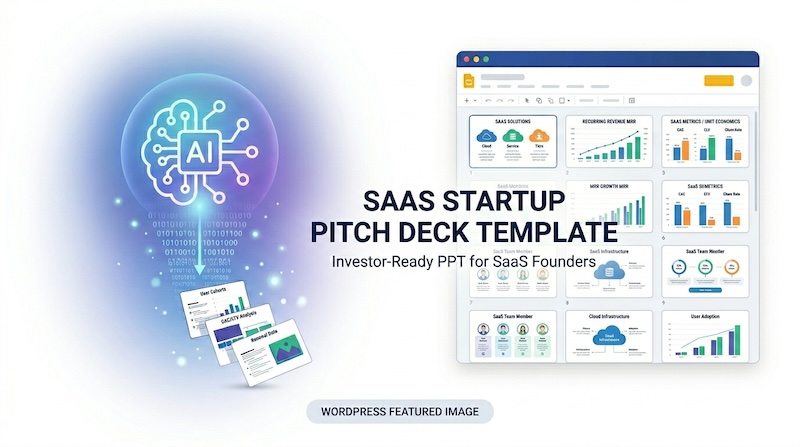
A SaaS startup pitch deck template helps SaaS founders present their product, metrics, and business model in a way that resonates with technical and non-technical investors. The difference between a generic pitch deck and a SaaS-specific one is how clearly it shows MRR, churn, LTV, and growth over time. A good template keeps your story consistent and prevents you from burying your most important numbers in the middle of the deck.
If you want to start from a professionally structured layout instead of a blank slide, you can download SaaS-focused PPT templates from our Startup & Pitch Decks category.
What SaaS Investors Expect in a Pitch Deck
SaaS investors care less about “cool features” and more about patterns that show sustainable growth. When an investor opens your SaaS deck, they are looking for answers to a few core questions:
- Who is your target customer and how painful is their problem?
- How does your product solve this better than existing tools?
- What is your revenue model and subscription structure?
- How healthy is your revenue, including MRR, ARR, churn, and expansion revenue?
- What are your unit economics, including CAC, LTV, and payback period?
- What is your product roadmap and how will it drive further growth?
- How much funding are you raising and which milestones will you hit with it?
A SaaS startup pitch deck template should help you answer these questions in a clear, data-driven flow, instead of treating the slides as a feature catalog.
Key Slides in a SaaS Investor Pitch Deck Template
A strong investor-ready SaaS deck tends to contain the same core slide types across rounds. Use your template as a skeleton and adapt each slide for your stage and story:
- Title & Team – your product name, one-line value, and core team members.
- Problem & Solution – what pain your users feel and how your SaaS product solves it.
- Market Size & Segments – total market and your target segments, ideally TAM/SAM/SOM or a simple big number.
- Product Overview / Demo – screenshots or UI flows that show your product in action.
- Business Model – how you charge customers, such as per seat, usage-based, or tiered pricing.
- Traction & Growth – MRR, ARR, number of customers, and growth rate over time.
- Churn & Retention – how often customers leave and how this trend is changing.
- Unit Economics – CAC, LTV, LTV/CAC, and payback period.
- Competition – where you sit versus other tools and your competitive edge.
- Product Roadmap – what you will build next and why it matters.
- Financials & Funding Ask – how much you are raising and how it translates into milestones.
If your template is missing some of these slide types, you can reuse existing “Content” or “Chart” slides by renaming them. Using a SaaS-focused template from the start saves time and keeps your deck aligned with what investors expect.
Customize a SaaS Pitch Deck for Different Funding Rounds
The same SaaS startup pitch deck template can work for seed, Series A, and even later rounds as long as you adjust the depth and emphasis of your numbers:
- Pre-seed / seed – focus on problem, solution, early traction, and evidence that people are willing to pay. Use revenue, trials, or waitlists as your main signals; keep LTV and payback high-level.
- Series A – show consistent MRR growth, cohort retention, and clear unit economics. Investors expect to see that you are not just spending heavily to acquire customers.
- Later rounds – add more detail on expansion revenue, net dollar retention, and multi-year projections. Still keep the deck simple enough to walk through in 15-20 minutes.
Using one flexible template across rounds means you can reuse your design system and only adjust the data and narrative depth.
Recommended PPTFOR SaaS Startup Pitch Deck Templates
If you do not want to build everything from scratch, you can start with one of the SaaS-focused layouts in our Startup & Pitch Decks category. For example:
- A streamlined SaaS pitch template for early-stage founders that emphasizes problem, solution, and early traction with minimal complex charts.
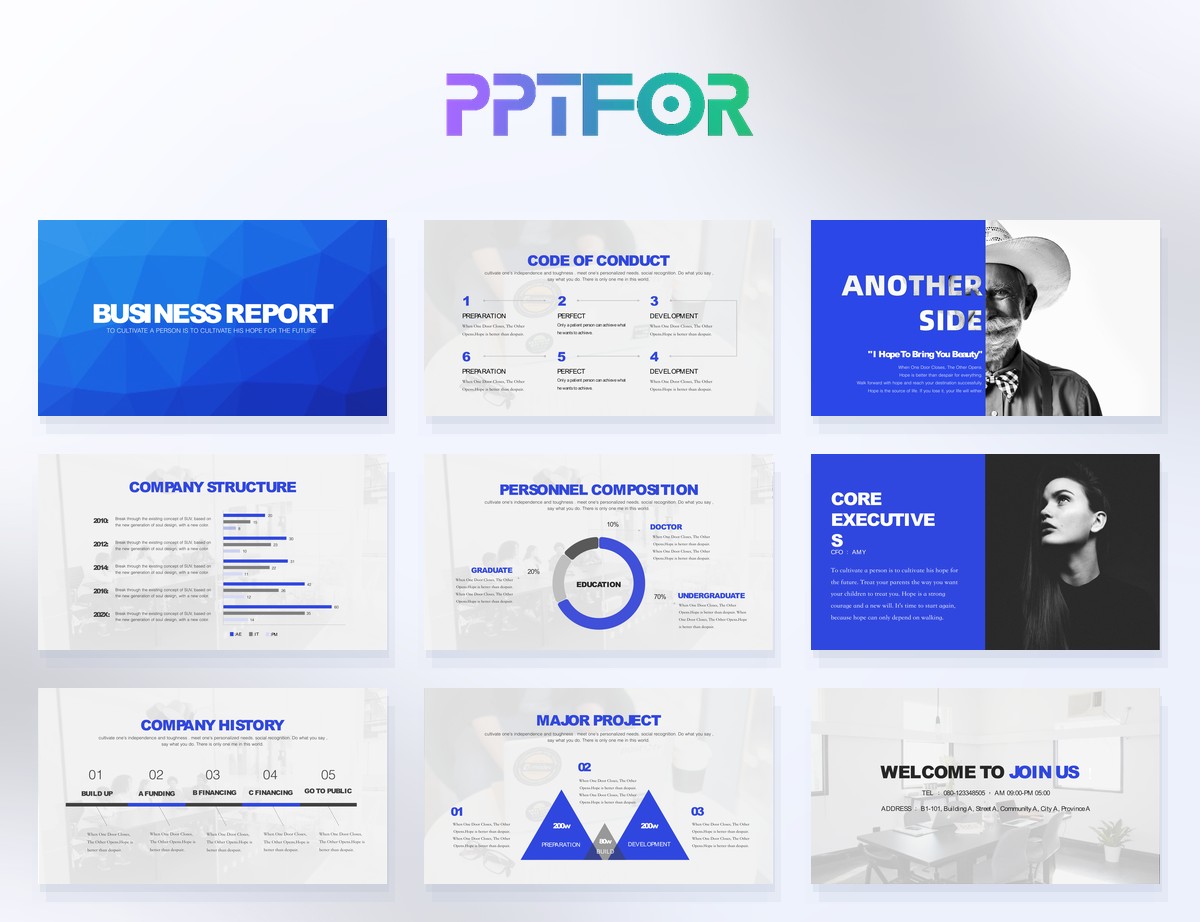
- A metrics-heavy deck with built-in slides for MRR, churn, LTV/CAC, and cohort analysis, useful for seed and Series A fundraising.
- Industry-specific SaaS decks for B2B, B2C, or vertical SaaS with placeholders for pricing tiers, customer types, and expansion revenue.
All of these templates are fully editable in PowerPoint, so you can change colors, fonts, and chart data to match your brand and keep SaaS metrics easy to read.
Step-by-Step: How to Use a SaaS Startup Pitch Deck Template
Follow these steps to turn a generic template into a SaaS-specific, investor-ready pitch deck that highlights your strongest metrics.
- Choose a SaaS-focused pitch deck template – Select a layout that already includes slides for Problem, Solution, Market, Product Demo, Business Model, Traction, Churn, Unit Economics, Roadmap, and Funding Ask, so you can focus on data instead of structure.
- Set up your MRR / ARR and growth slides – Use the MRR/ARR page to show a clean line chart over the last 12-24 months plus a few headline numbers, such as current MRR, growth rate, and net revenue retention.
- Configure the churn and retention slide – Add a small bar chart or 2-3 bullet points that show churn rate and retention over time, then explain what these numbers mean for your business.
- Build a unit economics slide that fits in 8-10 seconds – Use 3-4 labeled boxes for CAC, LTV, LTV/CAC, and payback period, each with one clear number and a short explanation.
- Design a product roadmap slide that links to metrics – Use 2-3 sections, such as Current, Next 6 months, and Next 12 months, and tie each milestone to an expected impact on MRR, churn, or LTV.
- Review the deck for investor readiness – Check that every slide contributes to one of the SaaS questions investors care about, simplify charts that are hard to read, and make sure your funding ask clearly maps to your growth plan.
Frequently Asked Questions
What makes a SaaS startup pitch deck different from a normal startup pitch deck?
A SaaS deck should highlight recurring revenue, churn, LTV, and growth over time. A template built for SaaS will give you dedicated space for these metrics and growth charts instead of only generic feature slides.
How many metrics should I show on a single slide?
Three to five main metrics per slide is ideal. If you need to show more detail, either break it into a second slide or move complex tables to an appendix or backup deck.
Can I reuse the same SaaS template for different investor types?
Yes. Use the same template base and change the emphasis for each round. For example, highlight growth for growth-stage investors and unit economics for seed funds. Keep the layout consistent while tailoring the data and narrative.
Where can I download a SaaS startup pitch deck template in PowerPoint?
You can download a SaaS startup pitch deck template in editable PPT format from our Startup & Pitch Decks category, optimized for SaaS and subscription-based businesses.
 Get full access to premium PowerPoint templates at a limited-time price.Get Now